Does Saying "Christ Is King" Make Someone a Christian?
“Having a form of godliness, but denying the power thereof.” — 2 Timothy 3:5
Nick Fuentes has drawn significant attention in recent years, stepping into the public eye while frequently weaving Christian language into his rhetoric. One phrase he is especially known for is “Christ is King.” On the surface, those three words sound like a bold, even courageous confession of faith — a banner raised in a culture that often wants Jesus silenced. And in a sense, the words themselves are gloriously true: Christ is King. He reigns over heaven and earth, and every knee will one day bow to Him.
But Scripture calls us to look deeper than appearances. The question is not whether the words are true. The question is whether the use of those words proves that a person truly belongs to Christ. And that leads us to one of the most important issues a believer can wrestle with in the public square: does Christian language mean a Christian heart?
The misconception: Christian words equal a Christian heart
It is tempting — almost automatic — to assume that anyone who quotes the Bible, defends Christian culture, or proclaims “Christ is King” must therefore be a brother in the faith. We hear familiar language, and our guard drops. We assume the best. And there is something good in that instinct toward charity. But charity is not the same as discernment, and Scripture refuses to let us measure a soul by its slogans.
The Bible itself issues a sober warning against this very assumption:
Having a form of godliness, but denying the power thereof: from such turn away.
2 Timothy 3:5 (KJV)
A form of godliness. The shape of it. The vocabulary, the posture, the appearance — all present, while the power that actually saves and transforms is absent. Paul is describing people who can sound thoroughly religious while remaining strangers to the new birth. Religious language and outward profession can coexist with a completely unregenerate heart. Words alone do not prove submission to Christ.
This is why true faith is never merely spoken. It is embodied. Christianity is not defined by slogans, movements, cultural identity, or religious labels. It is not defined by being against the right enemies or championing the right causes. Whether a person identifies as Catholic, Protestant, Orthodox, or otherwise, Christianity is defined by Christ Himself — living and reigning within a person through the power of the Holy Spirit. The throne in question is not merely a slogan on a banner; it is the throne of the human heart.
What the fruit reveals
Where Christ truly rules, there will be evidence. Not perfection, but unmistakable direction: repentance, humility, obedience, holiness, a love for truth, and a hatred of sin. The reign of Christ in a life produces the character of Christ in that life. And this is precisely the test Jesus Himself gave us:
Ye shall know them by their fruits. Do men gather grapes of thorns, or figs of thistles? … Wherefore by their fruits ye shall know them.
Matthew 7:16, 20 (KJV)
Notice what Jesus does not say. He does not say, “You shall know them by their slogans,” or “by their boldness,” or “by how loudly they invoke My name.” He says you will know them by their fruit — and fruit takes time. It is revealed not in a single dramatic moment but in consistency over the long haul. Fruit shows up in speech that aligns with Scripture, conduct that submits to Christ’s authority, and a heart posture that exalts God rather than self.
So discernment learns to ask deeper questions. When you listen to a public voice that claims the name of Christ, ask: What is actually being lifted up here? What is being defended? What sin is being minimized, excused, or even celebrated? And ultimately — who receives the glory? Is it the Lamb who was slain, or the man behind the microphone?
Proclaiming truth is essential; we are never called to silence. But proclaiming partial truth, distorted truth, or truth mixed with human pride leads people away from Christ rather than toward Him. A half-truth wrapped in Christian vocabulary can do more damage than open opposition, precisely because it wears the family colors. The true gospel does not place man at the center. It humbles man, exalts Christ, and calls all people — every last one of us — to repentance and obedience.
Two kinds of wisdom
Scripture gives us a striking way to tell the difference between what comes from God and what merely imitates Him. James draws a hard line between two completely different sources of wisdom:
This wisdom descendeth not from above, but is earthly, sensual, devilish. For where envying and strife is, there is confusion and every evil work. But the wisdom that is from above is first pure, then peaceable, gentle, and easy to be intreated, full of mercy and good fruits, without partiality, and without hypocrisy.
James 3:15-17 (KJV)
One wisdom is earthly, unspiritual, even demonic — driven by self-interest, dominance, and self-glorification. The other comes down from above and is pure, reverent, submissive to God, full of mercy, and unwavering in righteousness. These are not two flavors of the same thing. They flow from two different springs.
So when rhetoric — however religiously decorated — consistently produces arrogance, cruelty, division, or contempt for others made in God’s image, it is exposing its own source. It contradicts the Spirit of Christ, no matter how often or how loudly Scripture is quoted. The volume of a confession is not proof of its truth. A man can shout “Christ is King” and still be serving himself as king of his own kingdom.
Discernment is an act of obedience
Some Christians feel that testing other professing believers is unloving or judgmental. But Scripture frames discernment not as optional, and not as arrogance, but as obedience:
Beloved, believe not every spirit, but try the spirits whether they are of God: because many false prophets are gone out into the world.
1 John 4:1 (KJV)
We are commanded to discern, to test every spirit, and to expose falsehood. This is not the hobby of the suspicious; it is the duty of the faithful. But the same Bible that commands discernment also governs how we carry it out. We are to do it without corrupt speech, without slander, and without hatred — remembering always that we ourselves were once blind, and that we stand only by grace. Discernment that curdles into contempt has already failed the test it claims to administer.
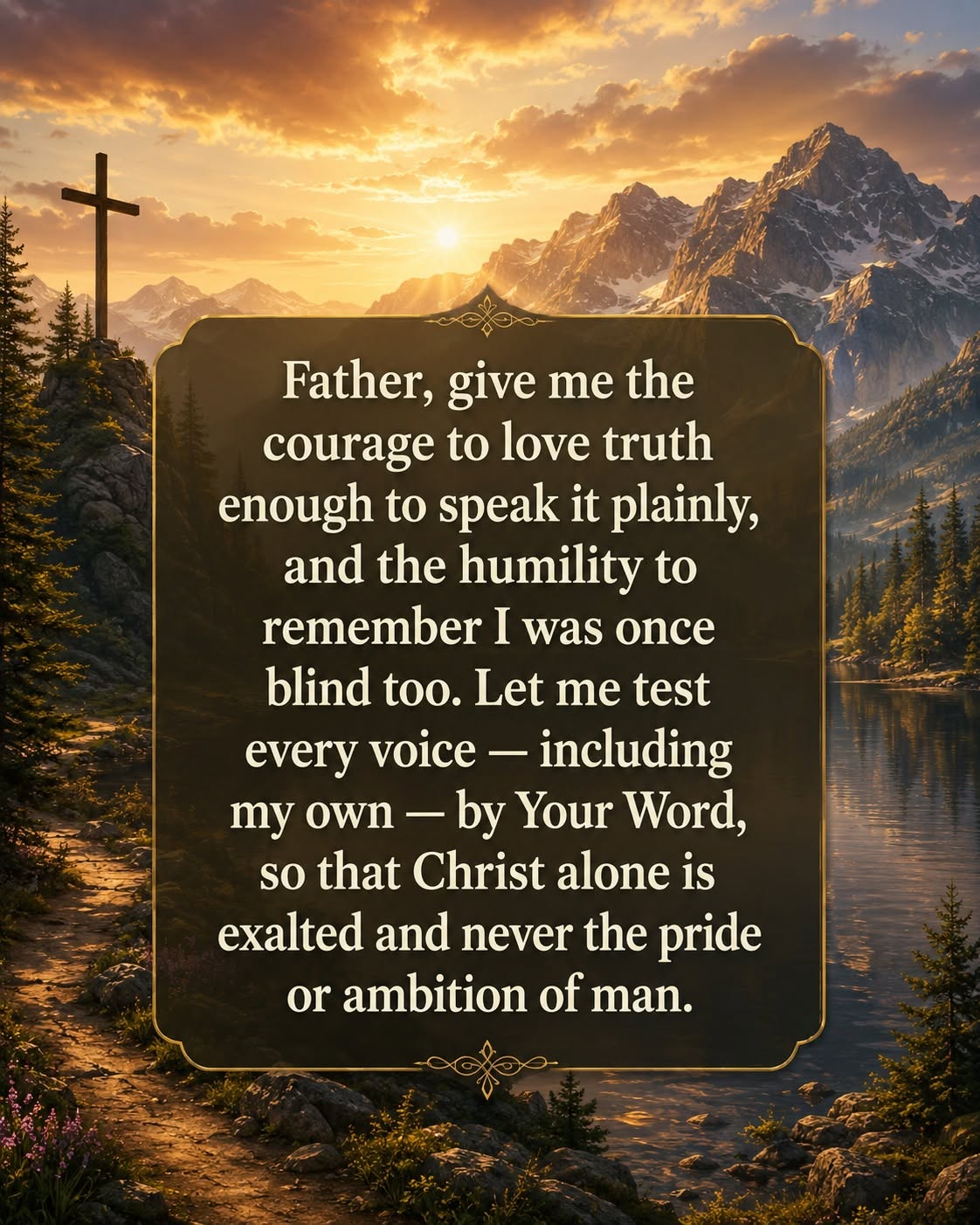
So let us put on the mind of Christ. Let us love truth enough to speak it plainly, and love people enough to speak it kindly. Let us examine fruit carefully and without fear, refusing to be swept along by zeal that has no holiness underneath it. And let us remain anchored in the true gospel — praying for genuine repentance, real transformation, and salvation, even for those whose words we must weigh and find wanting.
Our concern must never be personal loyalty, influence, or tribal identity. Our concern must be faithfulness to Christ. Anything that elevates man above God, power above holiness, or identity above repentance is simply not the gospel of Jesus — however many times it borrows His name. So yes, let the cry go up that Christ is King. But let it rise from a heart where He actually reigns.
🎥 Watch the full message: Nick Fuentes: Does Saying “Christ Is King” Make Someone a Christian?
Keep reading
Walking in Goodness, Righteousness, and Truth
Once we were darkness; now we are light in the Lord. The fruit of that light is goodness, righteousness, and truth — attributes that come not from ourselves but from the Spirit of God working through us.
Read more →
Misconception #4: Love Is a Feeling
The world says love is a feeling — tolerance of everything, whatever makes us feel good. Scripture says love is a moral quality of God's own character, always grounded in truth and never rejoicing in sin.
Read more →
Is the Bishop's Position Biblical? Examining the Sermon at Donald Trump's Inauguration
Testing a widely-shared inauguration sermon against Scripture — and why a message that sounds compassionate can still be a half-truth that leads people astray.
Read more →